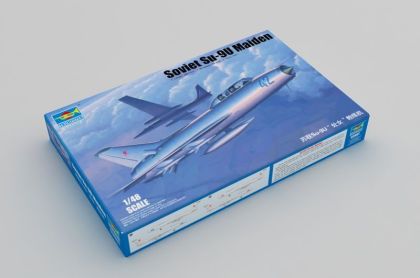
The Su-9's fuselage and tail surfaces resembled those of the Su-7, but unlike the swept wing of that aircraft, the 'Fishpot' used a 53° delta wing with conventional slab tailplanes.
The Su-9 had primitive R1L radar in the shock cone and was armed with four K-5 (AA-1 'Alkali') beam-riding air-to-air missiles. Like all beam-riders, the K-5 was so limited as to be nearly useless for air-to-air combat. Unlike the Su-7 and later Su-15, no Su-9 carried cannon armament, although two fuselage pylons were reserved for the carriage of drop tanks.
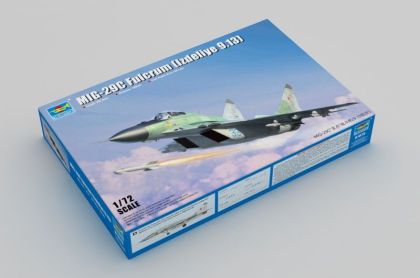
Since the Mig-29A were in service,the limited fuel capacity was the biggest problem of this light tactical fighter.To meeting the specified range requirements,the designers of Mikoyan developed a project to enlarge the fuselage tank.But the special dorsal auxiliary air intakes cause that only the tank in the spine could be readily enlarged;its capacity was increased by 240 litres.The enlarged fuselage tank made the upper fuselage contour became convex instead of concave.Besides,the application of new pylons allows another two drop tanks be fitted under the wings.Fitting three drop tanks gave the fighter a ferry range of 3000km.
A series of new electronic countermeasures equipments were also be fitted on the aircraft,and ordnance load increased to 3200 kg.
The prototype of the Mig-29C(Izdeliye 9.13) took off for the first time on 4th May 1984.More than 400 'fatbacks' were built.233 of them remained in Russia after
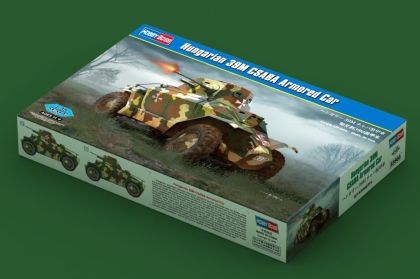
Hungarian expatriate Nicholas Straussler designed several armoured cars for Britainwhile living there between the two world wars. Straussler came to an agreement with the Weiss Manfred factory of Csepel, Budapest to produce vehicles from his designs for use in his home country - the most prominent was the Csaba (named after the son of Attila the Hun) which was designed based on his experience of the Alvis AC2 armoured car.After successful trials in 1939, the Hungarian Army placed an order for 61, and a further order for an additional 40 vehicles was placed in 1940. Of these, twenty were used as actual fighting vehicles, with the remainder serving as armoured command cars and reconnaissance vehicles.The Csaba had a 20mm cannon and an 8mm machine gun fixed on a centrally mounted turret, with 9mm armoured plating. The vehicle was also equipped with a detachable 8mm light machine gun fired through the rear hatch in the anti-aircraft role. The crew could dismou
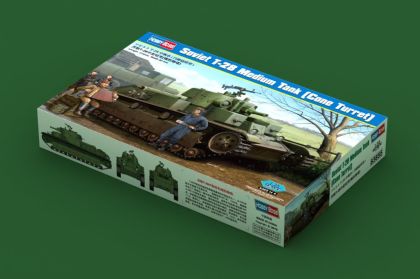
The Soviet T-28 was among the world's first medium tanks. The prototype was completed in 1931 and production began in late 1932. It was an infantry-support tank intended to break through fortified defences. The T-28 was designed to complement the heavier T-35, with which it shared many components. The type would not have that much success in combat, but it played an important role as a development project for the Soviet designers. A series of new ideas and solutions were tried out on the T-28 and were later incorporated in future models.
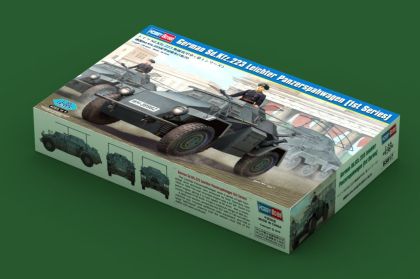
The Leichter Panzerspähwagen were a series of light four-wheel drive armoured cars produced by Nazi Germany from 1935 to 1944.The rear mounted engine was a 67 kW Horch 3.5 petrol engine, giving it a road speed of 80 km/h and a cross-country speed of 40 km/h. It had a maximum range of 300 km.
A radio car version, armed like the 221 with a 7.92 mm MG34 machine gun. Included additional radio equipment, and had a large "bed-frame" antenna over the vehicle. Over 500 of the SdKfz 223 were produced.
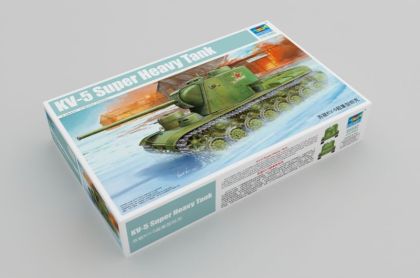
KV-5 (Object 225) - A cancelled project for a super-heavy tank. Armament was to be a 107 mm ZiS-6 gun in a large turret and machine-gun in a small secondary turret. Weight was projected as about 100 tons, and the tank was to have 150-180mm of armor. Project development began in June 1941, however was cancelled due to the Siege of Leningrad, in which all developmental operations at the Kirov Plant were halted. The project fell out of favour from the more advanced heavy tank designs, and no prototype was built.
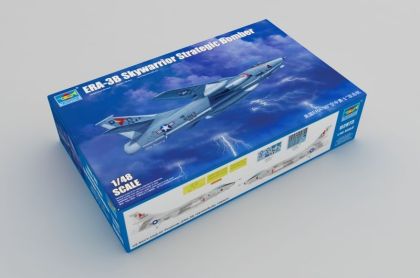
The Douglas A-3“Skywarrior”was a strategic nuclear bomber developed for the US Navy. The aircraft had a largely conventional semi- monocoque fuselage, with two J57 turbojet engines in underwing nacelles, A-3's wings can be folded for storage below deck, radar-controlled tail turret and a crew of three. The A-3 Skywarrior project started in 1947,The prototype XA3D-1 first flew on 28 October 1952, entered service with the Navy Heavy Attack Squadron One in 1956.Production ended in 1961. Douglas total built 282 Skywarriors.
Con il tuo consenso, possiamo utilizzare le informazioni elencate di seguito per gli scopi indicati di seguito o condividerle con partner selezionati. Per i singoli scopi (tipi di elaborazione), puoi modificare le tue impostazioni e confermare la tua scelta facendo clic sul pulsante "Salva impostazioni":
Sempre attivo
Cookie essenziali
Si tratta di file tecnici necessari per il corretto funzionamento dei nostri siti web e di tutte le loro funzioni. Vengono utilizzati, tra l'altro, per memorizzare i prodotti nel carrello, visualizzare i prodotti desiderati, controllare i filtri, le impostazioni personali e anche le impostazioni del consenso all'uso dei cookie. Per questi cookie non è necessario il Vostro consenso e non è possibile ritirarlo.
Cookie analitici
Contano le visite del sito web e, raccogliendo statistiche anonime, consentono all'operatore di comprendere meglio i propri visitatori e migliorare continuamente il sito.
Cookie di marketing
Raccolgono informazioni per un migliore adattamento della pubblicità ai vostri interessi, sia su questi siti web che al di fuori di essi.
Per facilitarti la navigazione nel sito, offrirti contenuti o annunci personalizzati e consentirci di analizzare anonimamente il traffico, utilizziamo i cookie che condividiamo con i nostri partner per i social media, la pubblicità e l'analisi. Puoi modificare queste impostazioni utilizzando il link "Modifica impostazioni" e puoi cambiarle in qualsiasi momento nel footer del sito. Ulteriori informazioni sono disponibili nella nostra Informativa sulla privacy e Utilizzo dei cookie.